Prior Art Search Tutorial: A Step-by-Step Guide

Whether you're a patent attorney preparing for prosecution, an inventor assessing patentability, or an IP professional conducting invalidity or freedom-to-operate research, knowing how to conduct a thorough prior art search is essential.
A strong prior art search does more than find patents with similar keywords. It looks across patents, academic papers, technical literature, standards, products, websites, and other public disclosures to determine what was already known before the relevant date.
This guide walks through a structured approach to prior art searching, from defining your search objective and building keywords to using classifications, citations, non-patent literature, international sources, and AI-powered semantic search.
Note: A prior art search is a research and discovery process, not a legal opinion. For high-stakes patentability, validity, infringement, or litigation decisions, findings should be reviewed by a qualified patent professional.
What Is Prior Art?
Prior art generally refers to information that was publicly available before the relevant date of an invention and may be relevant to determining whether a patent claim is new or inventive.
It can include:
- Patents and patent applications
- Academic papers and scientific journals
- Conference proceedings
- Technical standards
- Product manuals and documentation
- Publicly available websites
- Commercial products and demonstrations
- Software repositories
- Technical reports and white papers
- Other publicly accessible disclosures
The important point is that prior art is not limited to patent documents.
A search that only looks through patent databases can therefore miss important technical disclosures.
Why Conduct a Prior Art Search?
A prior art search can serve several different purposes, and the objective should determine how broad and deep the search needs to be.
| Search Type | Main Purpose | Typical Search Depth |
|---|---|---|
| Novelty / Patentability Search | Determine whether an invention appears new | High |
| Invalidity Search | Identify prior art that may challenge an existing patent | Very High |
| Freedom-to-Operate Search | Identify potentially relevant third-party rights | High |
| Landscape Analysis | Understand the technology and competitive space | Medium |
| Due Diligence | Assess IP risk before investment or acquisition | High |
For example, an early-stage inventor may begin with a focused patentability search, while an invalidity search may require extensive searching across patent databases, non-patent literature, jurisdictions, languages, citations, and historical sources.
Defining the objective first prevents you from spending time searching without knowing what level of coverage you actually need.
Step 1: Understand the Invention Before Searching
Before entering a keyword into a database, understand what you are actually searching for.
Start by identifying:
- What problem does the invention solve?
- What are its key technical features?
- Which components or steps are essential?
- Which features are optional?
- What technical field does it belong to?
- What alternatives could perform the same function?
- Which features are believed to be novel?
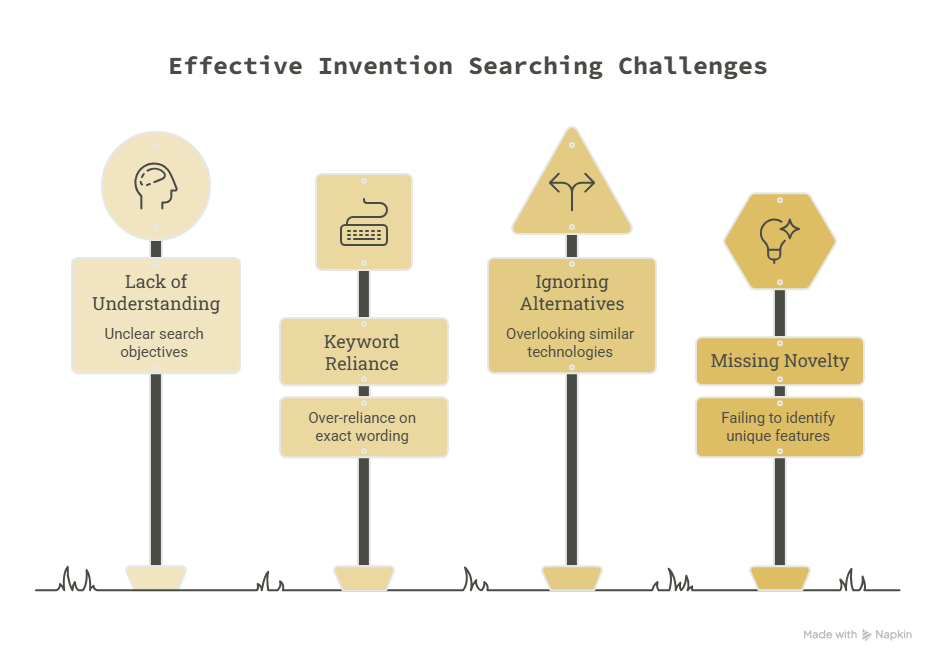
This prevents the search from becoming a simple hunt for documents containing the same wording as the invention.
Break the invention into searchable concepts
For example, suppose an invention involves an AI-powered patent search system.
Instead of searching only:
AI patent search
break the invention into concepts such as:
- Artificial intelligence
- Machine learning
- Natural language processing
- Patent search
- Prior art
- Semantic search
- Similarity matching
- Claim analysis
- Relevance ranking
- Vector embeddings
These concepts give you multiple routes into the prior art.
Step 2: Define the Search Scope
A good search begins with a defined scope.
Consider:
Technical scope
What technology, components, processes, or applications are relevant?
Geographic scope
Which jurisdictions matter?
Time scope
What publication or disclosure period is relevant?
Source scope
Will you search patents only, or also academic literature, standards, products, websites, and other public disclosures?
Claim scope
Which claim elements or technical features need to be investigated?
For complex searches, separating essential features from optional features can make the search significantly more efficient.
Step 3: Build a Keyword and Synonym List
Patent terminology is inconsistent.
The same technical concept may be described using completely different terminology in patents, academic papers, technical documentation, or older publications.
Create groups of:
Primary terms
The words most directly describing the invention.
Synonyms
Alternative terms used for the same concept.
Technical terminology
Specialized terminology used by engineers, researchers, or patent professionals.
Broader terms
Words describing the larger technical category.
Narrower terms
Specific components, methods, or implementations.
Historical terminology
Older words that may have been used in earlier disclosures.
For example:
Primary:
semantic patent search

Synonyms:
semantic retrieval
concept-based search
meaning-based search

Related:
AI patent search
automated prior art search
patent similarity search
Do not assume that the terminology used in a modern patent application was also used in older documents.
Step 4: Start With Broad Searches
Your first search should generally be exploratory rather than exhaustive.
Start with a few strong concepts and examine the results.
At this stage, the goal is to discover:
- New terminology
- Relevant patents
- Important inventors
- Assignees
- CPC and IPC classifications
- Earlier references
- Citation patterns
- Related technologies
A useful progression is:
Broad search → terminology discovery → relevant documents → classifications → citations → focused search
Trying to create the perfect search query immediately can actually make the search less effective.
Step 5: Use Boolean and Advanced Search Techniques
Once you understand the terminology, begin refining the search.
Common Boolean operators include:
AND— requires both conceptsOR— accepts either conceptNOT— excludes a concept"..."— searches an exact phrase
For example:
("semantic search" OR "concept search")
AND
("patent" OR "prior art")
You can then add technical terms, dates, classifications, inventors, or assignees.
The objective is not simply to reduce the number of results.
The objective is to improve the relevance of the results you actually review.
Step 6: Use CPC and IPC Classifications
Keywords are useful, but classifications can reveal relevant documents that use completely different terminology.
Two major patent classification systems are:
- CPC — Cooperative Patent Classification
- IPC — International Patent Classification
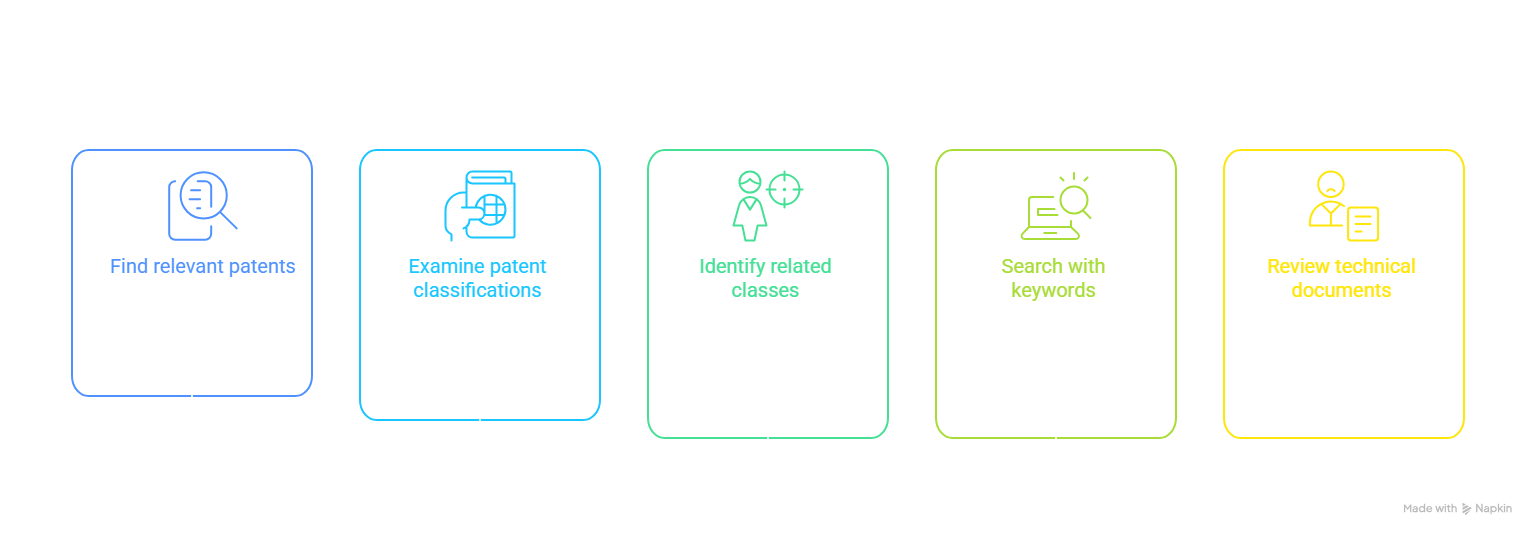
A practical classification workflow is:
- Find one or two highly relevant patents.
- Examine their CPC and IPC classifications.
- Identify the classes most closely related to your invention.
- Search those classifications with your keywords.
- Review earlier documents within those technical areas.
Classification searching is particularly useful when:
- terminology varies between countries
- older documents use different language
- searching across multiple languages
- the invention spans several technical disciplines
Classification codes can therefore act as a language-independent discovery layer.
Step 7: Search by Inventor and Assignee
Once you find a highly relevant document, do not stop there.
Look at:
- Inventors
- Assignees
- Related companies
- Earlier applications
- Later applications
- Other technologies associated with the same inventors
A relevant inventor may have published earlier work containing important disclosures that your original keyword search would never have found.
Likewise, an assignee's portfolio may reveal related technology using completely different terminology.
Step 8: Follow Patent Families
A single invention can appear in multiple jurisdictions and applications.
Patent-family searching can help you locate:
- Earlier publications
- Foreign-language versions
- Different publication dates
- Related applications
- Family members with clearer technical descriptions
A document that is difficult to interpret in one jurisdiction may have a corresponding family member with a clearer description or useful translation.
Patent-family searching is especially valuable when conducting international prior art research.
Step 9: Follow Backward and Forward Citations
Relevant documents often lead to other relevant documents.
Backward citations
These are references cited by a document.
They can help you move toward earlier disclosures.
Forward citations
These are later documents that cite the document you are examining.
They can reveal:
- Improvements
- Related inventions
- Competing approaches
- Additional terminology
- Technical developments
Citation searching is particularly useful when keyword searches stop producing useful results.
A strong search therefore does not simply ask:
"What documents match my keywords?"
It also asks:
"What documents are connected to the strongest references I have already found?"
Step 10: Search Non-Patent Literature
One of the biggest mistakes in prior art searching is assuming that every important disclosure will be in a patent database.
Non-patent literature (NPL) can include:
- Academic papers
- Scientific journals
- Conference proceedings
- Technical standards
- Technical reports
- White papers
- Product documentation
- Engineering publications
- University dissertations
- Software repositories
Research literature can sometimes disclose technical concepts before or around the time they appear in patent publications.
For a deeper workflow covering academic databases, citation searching, and research-paper discovery, see:
How to Find Patent Prior Art in Research Papers
Step 11: Search Research Papers and Academic Databases
Research papers deserve special attention in technical prior art searches.
Useful sources can include:
- Google Scholar
- Semantic Scholar
- The Lens
- CORE
- arXiv
- Subject-specific research databases
- Scientific journals
- University repositories
Begin with the terminology you developed during your patent search, then expand it using the language found in relevant papers.
You can also use citations from academic papers in the same way you use patent citations.
For example:
Research paper → earlier paper → technical disclosure → related patent
This can uncover prior art that a patent-only workflow would miss.
Step 12: Use Technical Databases Such as IEEE Xplore
For technologies involving engineering, electronics, computing, telecommunications, AI, or other technical disciplines, databases such as IEEE Xplore can add an important layer of coverage.
IEEE Xplore includes:
- Peer-reviewed journals
- Conference papers
- Technical standards
- Technical publications
- Other engineering and computing literature
When searching a technical database, use:
- Core keywords
- Synonyms
- Boolean operators
- Title and abstract fields
- Author filters
- Publication dates
- Conference or subject filters
For a more detailed database-specific workflow:
How to Use IEEE Xplore for Effective Prior Art Searches
Step 13: Search Foreign-Language Prior Art
A comprehensive international prior art search should not assume that all relevant disclosures will be in English.
Important technical disclosures can appear in:
- Chinese
- Japanese
- Korean
- German
- French
- Spanish
- Other local-language publications
Foreign-language searching can be approached through several layers.
Use classification codes
CPC and IPC classifications can help discover relevant documents without relying on exact English terminology.
Search patent families
A foreign-language publication may have an English-language family member.
Use machine translation for discovery
Machine translation can help determine whether a document is worth deeper review.
Use human review for critical documents
For litigation, FTO, or critical claim interpretation, important foreign-language references may require professional translation or technical review.
Use semantic search
AI-powered semantic systems can help connect concepts even when the terminology differs across languages.
For a deeper multilingual workflow:
How to Search Foreign Language Prior Art in English
Step 14: Use EPO Espacenet and Other International Databases
No single patent database should be treated as the entire prior art universe.
Useful resources can include:
- Google Patents
- USPTO Patent Public Search
- EPO Espacenet
- WIPO PATENTSCOPE
- The Lens
Espacenet is particularly useful for international patent research, patent families, classification searching, and accessing patent documents across jurisdictions.
It can be used alongside PatentScan as part of a broader workflow:
Database search → discovery → semantic search → family analysis → validation
For a dedicated workflow covering Espacenet and PatentScan:
Integrating EPO Espacenet with PatentScan
Step 15: Search Products, Websites, and Other Public Disclosures
Prior art is not limited to formal publications.
Depending on the invention, also consider:
- Product manuals
- Technical documentation
- Company websites
- Product pages
- Archived websites
- Public demonstrations
- Conference presentations
- Software repositories
- Industry publications
- Commercial products
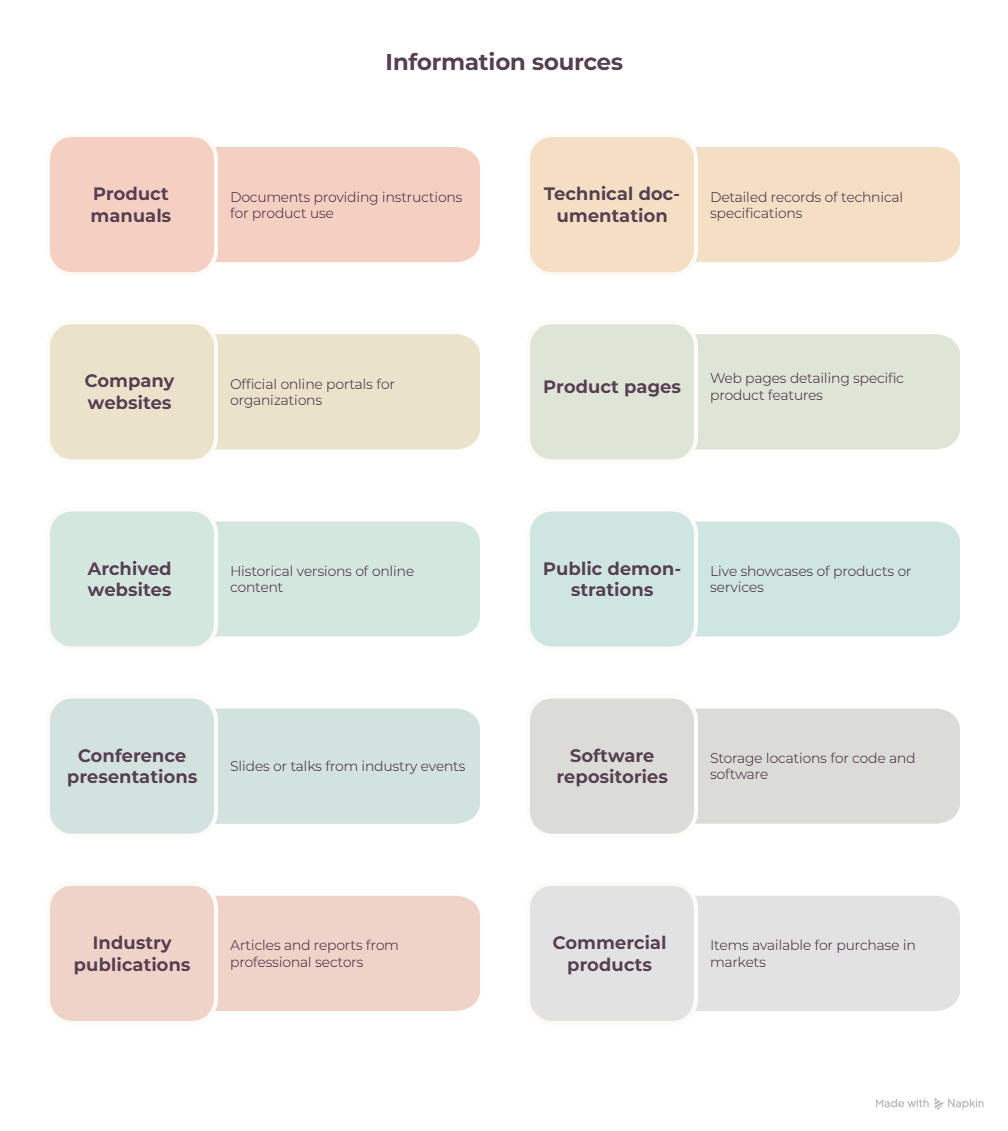 For older web material, archived versions can sometimes help establish what information was publicly available at a particular time.
The key question is:
Was the information publicly accessible before the relevant date?
Step 16: Search Multiple Sources, Not Just Multiple Databases
A comprehensive search is about source diversity as much as database diversity.
For a technical invention, you may need to combine:
Patent sources
Patents, applications, families, classifications, and citations.
Academic sources
Research papers, conference proceedings, dissertations, and journals.
Technical sources
Standards, engineering documentation, technical reports, and specifications.
Commercial sources
Products, manuals, websites, and public demonstrations.
Software sources
Repositories, documentation, and public technical releases.
Semantic sources
AI-powered systems that identify conceptually similar disclosures.
The objective is to build a search process where one source can lead you to another.
Step 17: Check Dates Carefully
Finding a technically similar document is only the beginning.
You also need to establish its timing.
Record relevant dates such as:
- Priority date
- Filing date
- Publication date
- Public availability date
- Conference or publication date
For non-patent literature, determine when the information was actually made available to the public.
Do not automatically assume that the earliest-looking date proves public availability.
Step 18: Evaluate the Actual Disclosure
A document is not necessarily relevant simply because its title, abstract, or keywords look similar.
Read the actual disclosure.
Ask:
- Does it disclose the relevant feature?
- Is the feature explicitly described?
- Is it shown in a figure?
- Is the required combination present?
- Is the technical relationship between elements disclosed?
- Does the document actually teach the relevant implementation?
This distinction is critical:
Similarity is not the same as disclosure.
Step 19: Build a Claim-to-Prior-Art Matrix
For more structured searches, map the important elements of the invention against each relevant reference.
For example:
| Claim Element | Reference A | Reference B | Reference C |
|---|---|---|---|
| Element 1 | ✓ | ✓ | — |
| Element 2 | ✓ | — | ✓ |
| Element 3 | — | ✓ | ✓ |
| Element 4 | ✓ | — | — |
This helps distinguish between:
- A document that discloses most of the invention
- Several documents that disclose different elements
- Documents that are only technically related
- Documents that provide useful background
It also makes it easier to identify which claim elements still require further searching.
Step 20: Use AI for Semantic Prior Art Discovery
Traditional keyword searching has an important limitation:
Different words can describe the same idea.
AI-powered semantic search can help identify documents based on conceptual similarity rather than exact keyword overlap.
For example:
"self-powered sensing system"
may be conceptually related to:
"energy harvesting sensor"
even though the wording is different.
AI-powered search can be particularly useful when:
- terminology varies significantly
- the invention is technically complex
- you are searching across multiple disciplines
- keyword searches produce noisy results
- you suspect relevant documents use different terminology
- you need to review large result sets
- you are searching across languages
The goal is not to replace conventional searching, but to expand what the search can discover.
Step 21: Combine Traditional Search With AI
The strongest workflow is usually hybrid.
Traditional methods provide:
- Exact terminology
- Boolean precision
- CPC/IPC searching
- Inventor and assignee searching
- Citation analysis
- Family analysis
- Date filtering
AI-powered methods provide:
- Semantic similarity
- Concept discovery
- Related-document discovery
- Faster screening
- Cross-language discovery
- Large-scale result analysis
A practical sequence is:
Keyword search → classifications → citations → NPL → multilingual search → semantic AI search → human validation
This combines precision with broader conceptual discovery.
Step 22: Use AI to Supplement USPTO Searches
USPTO searching remains an important part of U.S. patent research.
However, a USPTO-only workflow can be expanded by combining:
- USPTO searching
- Classification searching
- Citation analysis
- NPL searching
- Foreign patent searching
- Semantic AI search
This is particularly useful when conventional searches produce too many results or fail to uncover conceptually similar documents.
AI should therefore be treated as a supplement to established search methods, not as a reason to abandon them.
Step 23: Handle Search Overload
A comprehensive search can create another problem:
Too many results.
If you are reviewing thousands of documents, simply continuing to search is not necessarily productive.
Instead:
1. Identify your strongest references
Find the documents most closely related to the invention.
2. Extract their terminology
Use the language from strong references to build better searches.
3. Use classifications
Restrict results to relevant technical areas.
4. Search specific fields
Use title, abstract, claims, inventor, assignee, or date filters where appropriate.
5. Cluster related results
Group documents around the same technical concepts.
6. Prioritize high-value documents
Review likely relevant documents before spending time on low-value results.
The goal is not simply to reduce the number of results.
It is to increase the percentage of results that deserve human attention.
For more techniques:
How to Handle Too Many Patent Search Results
Step 24: Consider the Time Cost of Prior Art Searching
Prior art searching can consume significant attorney and analyst time.
A more efficient workflow can reduce repetitive searching by:
- Reusing terminology from strong references
- Following citation networks
- Using classifications
- Automating initial relevance screening
- Combining databases strategically
- Using semantic search
- Maintaining a structured search log
The objective is not simply to search faster.
It is to spend more time reviewing high-value evidence and less time repeatedly searching the same ground.
For a deeper look at the attorney-efficiency side of prior art research:
How Much Time Do Attorneys Really Spend on Prior Art Searches and How to Cut It
Step 25: Search Expired Patents
Expired patents can still be valuable research sources.
An expired patent may contain an earlier technical disclosure that helps you understand:
- How a technology developed
- Which concepts were already disclosed
- Earlier implementations
- Historical terminology
- Related patent families
The legal status of a patent and the informational value of its disclosure are different questions.
An expired patent should therefore not automatically be excluded simply because its rights are no longer active.
For a dedicated workflow:
How to Identify Prior Art from Expired Patents
Step 26: Look for What You Could Have Missed
A strong search should include a deliberate completeness check.
Ask:
- Did I search multiple patent databases?
- Did I search non-patent literature?
- Did I search relevant technical databases?
- Did I examine patent families?
- Did I follow backward citations?
- Did I follow forward citations?
- Did I search inventor portfolios?
- Did I search assignee portfolios?
- Did I search CPC/IPC classifications?
- Did I consider foreign-language publications?
- Did I search products and technical documentation?
- Did I check older terminology?
- Did I use both keyword and semantic approaches?
Missing prior art can create serious problems later, particularly when an important disclosure existed but was never discovered during the original search.
For more on the risks of overlooked prior art:
Overlooked Prior Art Consequences in Patent Cases
Step 27: Document the Search
A defensible search should leave behind a record of what was actually done.
Keep track of:
- Search dates
- Databases searched
- Keywords used
- Boolean strings
- CPC/IPC classifications
- Filters
- Inventors searched
- Assignees searched
- Relevant documents
- Important citations
- Reasons for excluding major references
- Translation methods used
- Final conclusions
A search log makes it easier to reproduce the process and identify gaps.
It also helps another researcher understand how the final set of references was reached.
The Five-Layer Prior Art Search Framework
For complex searches, it helps to think of prior art research as a layered process.
Layer 1: Define the Objective
First determine whether the search is for:
- Patentability
- Novelty
- Invalidity
- FTO
- Landscape analysis
- Due diligence
Different objectives require different levels of coverage.
Layer 2: Define the Technical Scope
Break the invention into:
- Components
- Functions
- Processes
- Relationships
- Technical effects
Layer 3: Discover Relevant Material
Search across:
- Keywords
- Synonyms
- CPC/IPC
- Inventors
- Assignees
- Patent families
- Citations
- NPL
- Foreign-language sources
Layer 4: Expand the Search
Use strong references to discover:
- Earlier documents
- Related inventions
- Different terminology
- Scientific literature
- Commercial disclosures
- Semantic similarities
Layer 5: Validate the Findings
Finally:
- Confirm relevant dates
- Review the actual disclosure
- Map claim elements
- Compare references
- Record evidence
- Document the search process
The layers build on one another.
Keyword searching establishes the starting point. Classification and citation analysis expand the search. NPL and international searching broaden coverage. Semantic AI can uncover conceptual relationships that keywords miss. Human review validates what actually matters.
When Should You Use an AI-Powered Prior Art Search Tool?
AI-powered search is particularly useful when:
- The invention is technically complex
- Terminology varies significantly
- Keyword searches are producing noisy results
- You need to search large patent collections
- Relevant documents may use different terminology
- You need faster initial discovery
- You need to supplement traditional database searches
- You are searching across languages or technical disciplines
AI can help reduce the manual burden of discovering potentially relevant documents, but the results still need to be reviewed.
The best use of AI is therefore not:
"Let AI decide what is prior art."
It is:
"Use AI to discover what a conventional search may have missed, then validate the evidence."
A Practical Prior Art Search Workflow
Here is a reusable workflow you can apply to most prior art searches.
1. Define the invention
Identify the problem, technical features, and essential elements.
2. Define the search objective
Decide whether the search is for patentability, invalidity, FTO, landscape analysis, or another purpose.
3. Build terminology
Create keyword, synonym, technical, broader, narrower, and historical terminology lists.
4. Run broad searches
Use a few strong concepts to discover terminology and relevant references.
5. Identify classifications
Extract useful CPC and IPC codes from relevant documents.
6. Search systematically
Combine keywords, classifications, inventors, assignees, dates, and citations.
7. Expand into non-patent literature
Search research papers, IEEE Xplore, standards, technical publications, and other NPL.
8. Search internationally
Review patent families and foreign-language publications.
9. Search public disclosures
Look at products, manuals, websites, repositories, and other technical material where relevant.
10. Add semantic search
Use AI to identify conceptually similar references that keyword searches may miss.
11. Validate
Review the actual disclosure, dates, and relevance of each important reference.
12. Map the findings
Create a claim-element or feature matrix.
13. Audit completeness
Check whether important databases, sources, languages, citations, and technical areas were missed.
14. Document everything
Maintain a clear search log and final report.
What Makes a Comprehensive Prior Art Search?
A comprehensive search is not necessarily the search that produces the most documents.
It is the search that covers the right sources, terminology, jurisdictions, technical areas, and discovery methods.
A strong search typically combines:
- Patent databases
- Patent classifications
- Keyword and Boolean searches
- Inventor and assignee searches
- Patent-family research
- Citation analysis
- Non-patent literature
- Technical databases
- Foreign-language searching
- Product and web evidence
- Semantic AI search
- Human validation
This combination reduces the risk of relying too heavily on one database or one search technique.
Common Prior Art Search Mistakes
Searching only one database
No single database should automatically be treated as a complete prior art universe.
Searching only exact keywords
Older and foreign documents may describe the same technology using different terminology.
Ignoring non-patent literature
Important technical disclosures can exist outside patent databases.
Ignoring foreign-language documents
A relevant disclosure may have been published in another language.
Stopping after finding one relevant patent
A strong reference should lead to more searching through classifications, citations, families, inventors, and related technologies.
Treating similarity as disclosure
A document that looks similar may not actually disclose the required technical combination.
Ignoring expired patents
An expired patent can still contain valuable historical technical disclosure.
Failing to manage search overload
More results do not necessarily mean a better search. Relevance and coverage matter more than raw volume.
Failing to document the search
Without a search record, it becomes difficult to understand what was searched and what may have been missed.
Assuming AI is sufficient by itself
AI can improve discovery, but important references still require human review and validation.
Key Takeaways
- Prior art is broader than patents alone.
- Start by understanding the invention and defining the search objective.
- Build synonym and terminology lists before conducting deeper searches.
- Use CPC and IPC classifications to overcome terminology differences.
- Search inventors, assignees, patent families, and citations.
- Search academic papers and other non-patent literature.
- Use technical databases such as IEEE Xplore when relevant.
- Include foreign-language and international sources in comprehensive searches.
- Search products, websites, standards, manuals, and other public disclosures when relevant.
- Expired patents can still provide useful historical technical disclosures.
- Semantic AI search can uncover conceptually similar prior art missed by exact keywords.
- The strongest workflow combines traditional searching, AI-assisted discovery, and human validation.
- Manage search overload by prioritizing relevance rather than simply collecting more results.
- Document the search so the process can be reviewed and reproduced.
- Always verify the actual disclosure and relevant dates before relying on a reference.
Frequently Asked Questions
What is a prior art search?
A prior art search is a systematic investigation of publicly available information that may be relevant to determining whether an invention is new, inventive, or affected by earlier disclosures.
What sources should be included in a prior art search?
Depending on the search objective, sources can include patents, patent applications, academic papers, technical publications, standards, product documentation, websites, software repositories, and other public disclosures.
Is Google Patents enough for a prior art search?
Google Patents is a valuable starting point, but a comprehensive search should generally use multiple sources and techniques, including classifications, citations, patent families, NPL, international databases, and potentially semantic search.
How can AI help with prior art searching?
AI can help identify conceptually similar documents, expand terminology, screen large result sets, and discover relationships that traditional keyword searches may miss. Human review is still important for validating relevance and disclosure.
Should foreign-language patents be included?
Yes. A comprehensive international search should consider foreign-language publications when they are relevant to the technology and search objective.
Why is non-patent literature important?
Research papers, technical publications, standards, and product documentation can contain technical disclosures that may not appear in patent databases.
Can expired patents still be useful?
Yes. Their legal status may have changed, but their technical disclosures can still be relevant to historical research and prior art analysis.
How do I know whether a document is actually relevant?
Read the disclosure rather than relying only on the title or abstract. Determine whether the document actually describes the relevant technical features, relationships, and implementation.
Related Prior Art Resources
For deeper coverage of specific parts of the search process:
- Integrating EPO Espacenet with PatentScan
- How to Find Patent Prior Art in Research Papers
- How Much Time Do Attorneys Really Spend on Prior Art Searches and How to Cut It
- How to Search Foreign Language Prior Art in English
- Overlooked Prior Art Consequences in Patent Cases
- How to Use IEEE Xplore for Effective Prior Art Searches
- How to Identify Prior Art from Expired Patents
- How to Handle Too Many Patent Search Results
Final Thoughts
A strong prior art search is not about finding one document that looks similar to an invention.
It is about building a structured picture of what was publicly disclosed, where it was disclosed, when it became available, and how closely those disclosures relate to the technology being investigated.
Start broad. Refine systematically. Search beyond patents. Follow classifications and citations. Look internationally. Include non-patent literature. Use AI where it adds discovery value. And most importantly, validate the actual evidence before drawing conclusions.
The better the search methodology, the more confidence you can have in the results.
Ready to Run Your Own Prior Art Search?
Start with a free search and see how quickly PatentScan can turn an idea into a structured prior art search workflow.